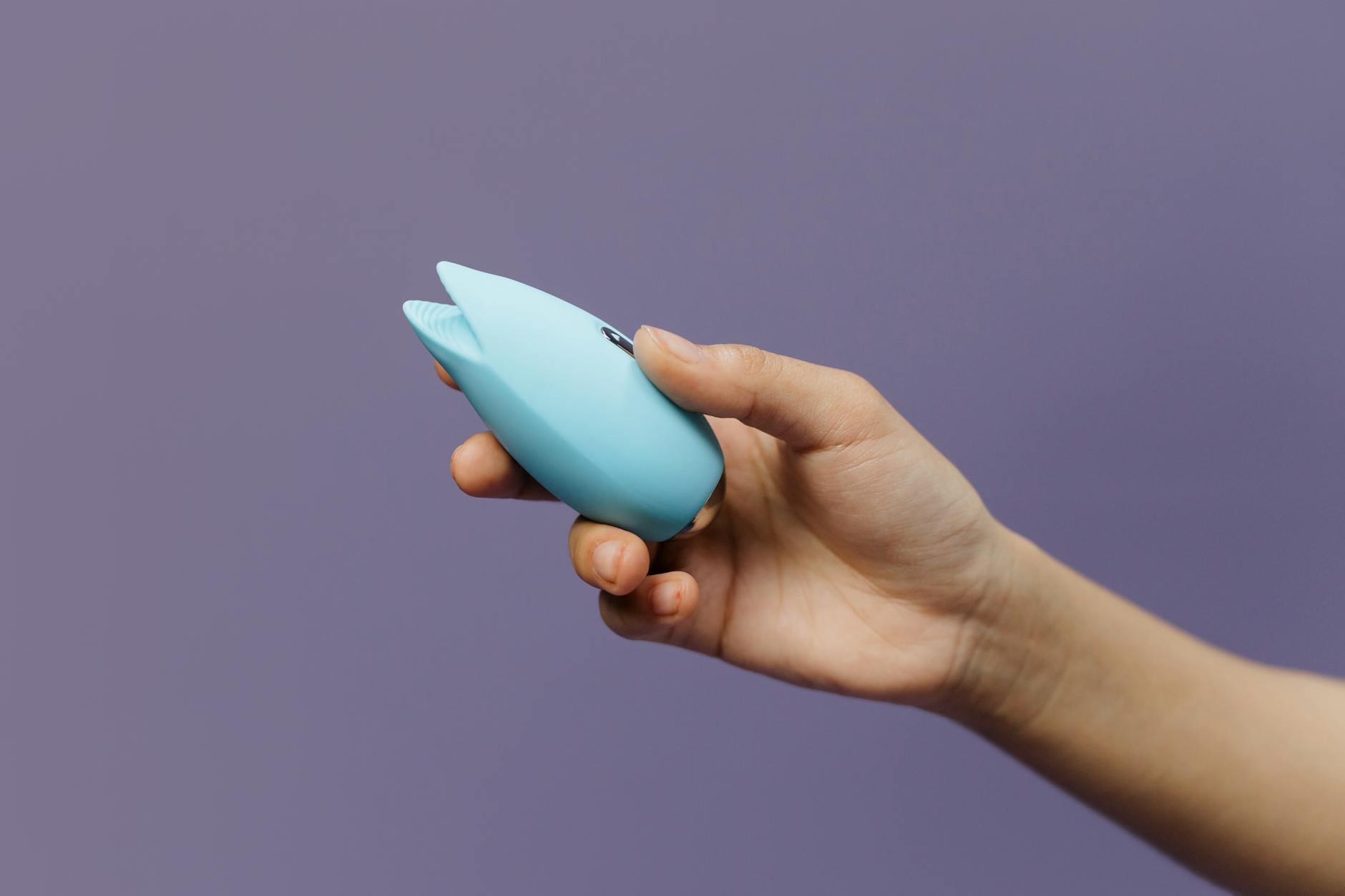
Here's what anxiety actually does to pleasure
Anxiety doesn't just make you nervous. It hijacks your autonomic nervous system and locks you into fight-or-flight mode. Your body becomes hypervigilant. Your pelvic floor tightens. Blood flow redirects away from your genitals and toward your limbs. Your brain floods with cortisol instead of dopamine. Before you even touch yourself, your physiology has already decided pleasure is off the table.
This is not a psychological problem. It's not something you think your way out of. It's a nervous system problem that needs a nervous system solution.
Lemon vibrators work because they bypass the thinking part of anxiety and speak directly to your body's sensory system. They give your nervous system something so compelling to focus on that the anxiety narrative gets backgrounded. Not eliminated. Backgrounded.
Why vibration works better than touch when anxiety is high
When you're anxious, self-touch often amplifies the problem. You're aware of your own touch. You're thinking about whether you're doing it right. You're listening for sounds. You're checking the time. Your brain stays in the audience seat, criticizing the show.
Vibration is different. The sensation is so distinct and rhythmic that it captures your attention in a way your own fingers cannot. It's almost involuntary. Your nervous system recognizes it as external input, which paradoxically makes you feel safer because you're not the one generating it. You're receiving it.
Lemon clitoral vibrators like the Lem operate at frequencies designed to stimulate without overwhelming. They don't ask you to do anything. You set it down, and it does the work. This passivity is therapeutic when anxiety usually means you're managing everything in your head.
The neurobiology of suction versus traditional vibration
Most vibrators work through direct oscillation. They buzz. That's fine for many people, but if you're anxious, that constant trembling can sometimes feel like stimulation that mirrors your nervous system's own agitation. Some people describe it as feeling like their anxiety is being amplified.
Suction-based clitoral vibrators operate differently. They create a gentle vacuum around the clitoris rather than vibrating against it. This feels less like intensity and more like a slow build. It requires less muscular tension to enjoy. Your pelvic floor can stay relatively relaxed, which means your whole nervous system stays more settled.
If you're new to using vibrators and anxiety is your primary blocker, start with suction. Give yourself permission to choose the gentler architecture.
Setting up your environment for nervous system safety
Your physical environment is part of your nervous system's assessment. Anxiety makes you hyper-aware of every potential interruption, every sound, every way things could go wrong. Before you use any lemon vibrator, you need to engineer safety into your surroundings.
Lock the door. Actually lock it, don't just close it. Tell your household you need 30 minutes alone. Put your phone in another room. Close the curtains if you need to. These aren't paranoid steps. They're pragmatic ways to tell your nervous system there's nothing left to defend.
Temperature matters too. A cold room keeps you tense. Warm yourself up first. Light a candle if scent helps you relax, though avoid anything too stimulating. Keep water nearby. Sometimes anxiety creates thirst as your body prepares for threat response.
The goal is to remove every micro-stressor your anxious brain is scanning for, so when you pick up your vibrator, there's genuinely nothing left to worry about.
The breathing pattern that rewires anxiety during pleasure
Anxiety shallows your breath. You stop moving air through your diaphragm and start panting. This keeps your nervous system locked in sympathetic mode.
Before you start using your lemon vibrator, spend two minutes on box breathing. Inhale for four counts, hold for four counts, exhale for four counts, hold for four counts. Do this five times. You're not meditating. You're not trying to be zen. You're literally telling your vagus nerve to downregulate.
Once you start using the vibrator, keep breathing. The temptation with anxiety is to hold your breath when sensation gets intense. That's the old pattern. Instead, exhale fully as sensation builds. Long exhales send a safety signal to your nervous system. They say: this is pleasure, not threat.
Many of my clients find that the breathing pattern matters more than the vibrator itself. The vibrator is the permission structure. The breathing is the actual rewiring.
Starting with ultra-low intensity and working sideways
When anxiety is high, intensity feels threatening. Most people assume they need to work up to higher settings, but if your nervous system is already taxed, jumping to setting three or four can feel like overstimulation, which triggers more anxiety. A spiral.
Start with setting one. Seriously. Set one on a lemon vibrator is almost meditative. It's not about getting to an orgasm. It's about proving to your nervous system that this sensation is safe and that your body can receive pleasure without everything falling apart.
You might use your vibrator on setting one for weeks. That's not failure. That's retraining. Every time you use it safely and nothing bad happens, your nervous system's threat assessment gets updated. Anxiety depends on catastrophic predictions. Repeated proof that those predictions were wrong is what actually changes the wiring.
Then move sideways before you move up. Try different patterns instead of higher intensity. Many lemon vibrators have pulsing, waves, or rhythms that cycle. Explore those. Let variety replace speed.
The partner conversation if anxiety is relationship-rooted
Sometimes anxiety during pleasure is free-floating. Sometimes it's because your partner has signaled (directly or subtly) that your pleasure doesn't matter, or matters less than theirs, or comes with strings attached.
If that's true for you, using a lemon vibrator isn't enough. You need to have a conversation. Not during sex. Not during an argument. Sometime neutral, planned, when you're both calm and fed.
You might say: "I want to use vibrators as part of my solo pleasure routine. It helps me feel safe and present. I need you to know this isn't about you or about something missing between us. It's about me healing my relationship with my own body."
Then you listen. If your partner responds with shame or jealousy or ownership language, that's information about your relationship that goes beyond this blog post. You may need a couples therapist, not a vibrator guide.
But if your partner responds with support, make a specific request: "I need 30 minutes alone twice a week without checking in." Set a boundary and keep it. Your nervous system will notice that you're protecting your own pleasure.
Why orgasm isn't the goal when anxiety is the issue
Here's the thing I need to say clearly: if you're using a lemon vibrator to fix anxiety, the orgasm is not the marker of success. The marker is sensation without panic. Pleasure without guilt. Five minutes of relief without your nervous system hijacking the experience.
You might use your vibrator and not orgasm. That's completely fine. You might feel sensation and then anxiety creeps back and you stop. That's also fine. That's progress. Every time you do this, your nervous system is learning.
Orgasms will come back when your nervous system believes it's safe to have them. You can't think your way into that belief. You have to prove it through repeated experience. Your vibrator is the tool for that proof.
When professional support is the real answer
If anxiety is severe enough that you can't use a vibrator at all without panic, or if pleasure triggers flashbacks or dissociation, vibrators alone won't solve this. That's not a limitation of lemon clitoral vibrators. That's a sign you need a trauma-informed therapist.
I recommend someone trained in somatic therapy or EMDR. They can help rewire the connection between your nervous system and pleasure at a deeper level. Then, once you've got professional support in place, vibrators become part of the toolkit. They're not the first step.
If you're not sure whether you need professional help, ask yourself: "When I try to pleasure myself, do I feel panic or physical symptoms like racing heart or can't-breathe sensation?" If yes, talk to a therapist before going deeper into solo play.
The real shift happens in the nervous system
Lemon vibrators work for anxiety because they're a physical intervention for a physical problem. Anxiety lives in your body. Your vibrator lives in your body. They speak the same language.
Use it regularly. Not obsessively. Two to three times a week is enough to tell your nervous system that pleasure is a safe, available thing. Stay with low intensity. Keep breathing. Stop if you need to. Your body will tell you when it's ready for more.
This isn't about becoming a pleasure expert. It's about becoming someone whose nervous system trusts that sensation and safety can coexist. That shift changes everything.
People Also Ask
Can you use lemon vibrators if you have panic disorder?
Yes, though you may need to start more gradually. If you have panic disorder, your nervous system is already primed to interpret physical sensations as threat signals. A vibrator might initially feel alarming simply because it's a new sensation. Start with the quietest setting for 30 seconds at a time. Build tolerance slowly. If at any point you experience panic symptoms, stop and seek professional support. A trauma-informed therapist can help you retrain your body's panic response alongside vibrator use.
Does anxiety medication affect how vibrators feel?
Most SSRIs and anti-anxiety medications can reduce sensation or delay orgasm. This isn't a reason to avoid lemon vibrators. It actually means vibrators become more useful because they can provide stronger sensation than solo touch. Talk to your prescriber if you're concerned, but don't assume medication makes pleasure impossible. It just means you might need a longer warm-up time or different patterns.
How long does it take for anxiety to stop blocking pleasure?
That depends on the severity of anxiety and how consistently you practice. Some people feel a shift in two weeks. Others need two to three months of regular use. What matters is consistency, not intensity. Using your lemon vibrator twice a week for three months will rewire your nervous system more effectively than daily use for two weeks followed by a month off.
Is it normal to feel more anxious the first time using a vibrator?
Completely normal. Your nervous system is encountering a new sensation, and anxiety interprets new as potentially dangerous. That initial discomfort usually passes within the first few uses. If it doesn't, or if it gets worse, that's useful information. It might mean you need a different approach or professional support.
Can using lemon vibrators actually reduce your baseline anxiety over time?
Regularly engaging in pleasure that your nervous system perceives as safe does tend to lower overall anxiety. You're not curing an anxiety disorder with a vibrator. But you are proving to your body that sensation and safety can coexist. That retraining has downstream effects on your nervous system's overall threat assessment. Over months, many people notice they feel less anxious in general.
What if my anxiety comes back during pleasure even after weeks of practice?
Anxiety isn't linear. Stress, sleep, hormones, and life events all affect your nervous system's baseline. Sometimes anxiety will spike even after you've made progress. This doesn't mean you failed or that vibrators don't work for you. It means you pause, go back to setting one, reconnect with your breathing, and remember that you've done this before. Your nervous system will recalibrate.
If you're ready to start exploring lemon clitoral vibrators as part of reconnecting with your pleasure, begin with <a href="/faqs">our FAQs</a> to understand what to expect. And if anxiety or trauma feels bigger than what a vibrator can address alone, <a href="/contact">reach out to us</a>. We can point you toward resources and professionals who specialize in nervous system healing.